
Brain-Computer Interface Upper Limb Rehabilitation: What It Is and What the Evidence Shows

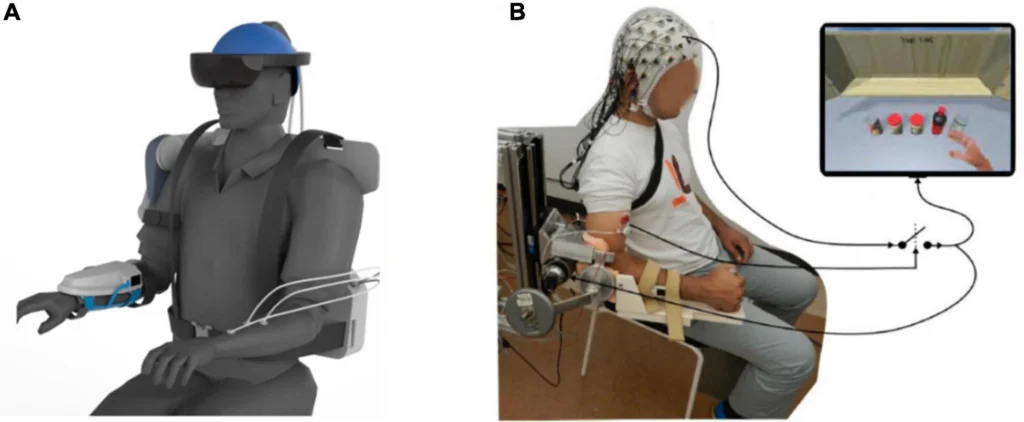
A brain-computer interface (BCI) for upper limb rehabilitation reads brain signals linked to intended movement and turns them into feedback, so people can practise arm and hand tasks after a stroke. Reviews from 2018–2024 report a moderate average benefit, strongest with functional electrical stimulation, but studies remain small and heterogeneous; BCI is studied as an adjunct to supervised therapy.
Rehabilitation, as defined by the World Health Organization, is a set of interventions designed to optimise functioning and reduce disability in people with health conditions. A BCI adds a direct channel between brain activity and a computer, which is why researchers study it for upper limb movement after stroke. The technology combines signal recording, software decoding and sensory or motor feedback, and the main designs differ in each of those three parts.
How a BCI upper limb session works
A BCI upper limb session follows a repeating loop: the person thinks about moving their arm or hand, software interprets the brain signal, and a device gives feedback so the movement attempt becomes practice. Sessions are studied as part of supervised rehabilitation, not as a standalone replacement.
- Signal acquisition. Electrodes on the scalp record electrical brain activity, commonly sensorimotor rhythms linked to movement.
- Decoding. Software translates the recorded signal into a command, often using algorithms trained on the person's own brain patterns.
- Feedback. The command drives a screen, electrical stimulation or a robotic device, giving the person visible or physical feedback.
- Repeated practice. The loop repeats many times during a therapy session, providing the repetition that therapists already use in conventional programmes.
This repetition is the mechanism behind most rehabilitation, and the BCI adds a way to tie the feedback directly to the person's own movement intention rather than to a therapist's manual cue.
What the evidence says
Systematic reviews and meta-analyses from 2018–2024 on brain-computer interface stroke upper limb rehabilitation have consistently reported a benefit, but the exact size depends on the BCI design and the comparison group. The table below summarises three review-level sources.
| Source | Year | Focus | Reported effect or limitation |
|---|---|---|---|
| Cervera et al. | 2018 | Post-stroke motor rehabilitation RCTs | Reported a summary benefit for upper limb trials; authors emphasised small samples and heterogeneity |
| Mansour et al. | 2022 | BCI design in upper-limb RCTs | Hedge's g 0.73 for intention-of-movement protocols and 0.33 for motor imagery protocols |
| Ren et al. | 2024 | BCI plus functional electrical stimulation | Standardised mean difference 0.50 across 10 randomised controlled trials with 290 participants |
These reviews are indexed in PubMed, which lets readers check the original abstracts and methods. The figures above are useful but should be read with the limitations in later sections.
BCI designs compared
The effect of a BCI depends on what signal is recorded, how it is decoded, and what feedback follows. The table below compares the designs most commonly studied.
| Design | Brain signal | Decoding | Feedback | Reported effect | Typical limitation |
|---|---|---|---|---|---|
| Motor imagery | Sensorimotor rhythms, often band power | Band power or common spatial patterns | Visual or simple on-screen tasks | Hedge's g about 0.33 | Visual feedback alone may not engage motor pathways strongly |
| Intention of movement | Sensorimotor rhythms, often task-related | Common spatial patterns or band power | Robotic or electrical | Hedge's g about 0.73 | Protocols vary, making pooled estimates less certain |
| BCI-FES | Motor-related activity | Varied | Functional electrical stimulation | SMD 0.50 | Stimulation settings and electrode placement vary widely |
Common spatial patterns and band power are two ways of representing the sensorimotor rhythm; both appear in the literature, which adds to the heterogeneity. The numbers are moderate on standard effect-size scales, but they come from research settings where protocols, equipment and participant characteristics differ. That is one reason why no single BCI design can be described as the standard.
The 2016 Duenser low-cost system: components and what it tested
A 2016 conference paper by Duenser and colleagues, presented at the International Conference on Disability, Virtual Reality and Associated Technologies (ICDVRAT), described the development of a low-cost upper limb rehabilitation BCI eye-tracking system combining a brain-computer interface, eye-tracking and additional sensors. The authors framed the work as development rather than a completed randomised trial, so the paper offers a design snapshot rather than an efficacy estimate.
The components were:
- BCI: reads brain signals tied to intended upper limb movement.
- Eye-tracking: records where the person is looking, which can guide attention and task setup.
- Additional sensors: extend the system beyond the BCI alone; the title identifies the combination as the core contribution.
What remains useful is the architecture: low-cost components assembled for upper limb rehabilitation, an early example of the trend toward portable, accessible assistive technology. The combination of eye-tracking and BCI is notable because eye gaze can indicate attention and intention, but its added clinical value was not established by the 2016 paper.
What remains uncertain and how to read the studies
- Most trials are small. The Ren 2024 meta-analysis pooled 10 randomised controlled trials with 290 participants.
- Protocols differ in signal, feedback and session length, which limits direct comparison.
- Follow-up is often short, so durability beyond a few weeks is unclear.
- Many studies compare BCI to usual care, not to another active intervention matched for time and attention, which may overstate the specific effect.
- Quality ratings vary, and several reviews call for larger, multi-centre trials.
These cautions do not mean the evidence is weak; they mean the average effect is best understood as a promising signal from a young field.
Who BCI upper limb rehabilitation is for
BCI upper limb rehabilitation is studied mainly in adults with arm weakness after a stroke. It may be relevant for people who can take part in supervised therapy and can tolerate wearing a headset and completing repetitive tasks. It is a research-supported approach, not a home remedy; the NHS describes stroke recovery as built around a personalised rehabilitation plan with professional support. No treatment decision should be made from reading this alone.
How to read the evidence
Standardised mean difference (SMD) and Hedge's g both express the difference between two groups in units of standard deviation. Values around 0.2 are considered small, around 0.5 moderate, and around 0.8 large. Hedge's g is a corrected version of SMD that performs better with small samples. A moderate average effect does not mean every person improves; it means the average change in the BCI group exceeded the comparison group by about half a standard deviation in the pooled studies.
Editorial notes
This material summarises published rehabilitation research for readers who are not specialists and does not give medical advice. Further notes are on the About page.
FAQ
How does BCI upper limb rehabilitation work?
It records brain activity linked to movement and turns it into visual, electrical or robotic feedback so the person practises repeatedly.
Does BCI improve upper limb function after stroke?
Reviews from 2018–2024 report a moderate average benefit, with the strongest evidence for BCI plus functional electrical stimulation.
What is BCI-FES?
A design that pairs a brain-computer interface with functional electrical stimulation to move the arm or hand when movement intention is detected.
Is BCI upper limb rehabilitation available at home?
Evidence supports supervised, research-based use; home use is still limited and should not replace professional guidance.
Sources
World Health Organization. Rehabilitation fact sheet, 22 April 2024. NHS. Recovering from a stroke, page last reviewed 12 September 2024. PubMed. National Library of Medicine biomedical literature search. Cervera et al. “Brain-computer interfaces for post-stroke motor rehabilitation: a meta-analysis.” 2018. Mansour et al. “Efficacy of brain-computer interface and the impact of its design characteristics on post-stroke upper-limb rehabilitation: a systematic review and meta-analysis of randomized controlled trials.” 2022. Ren et al. “The effect of brain-computer interface controlled functional electrical stimulation training on rehabilitation of upper limb after stroke: a systematic review and meta-analysis.” 2024. Duenser et al. “Development of a low-cost upper limb rehabilitation system using BCI, eye-tracking and other sensors.” Proceedings of ICDVRAT, 2016.
Further reading