
Motion Tracking in Virtual Rehabilitation: Technology, Evidence and Limits

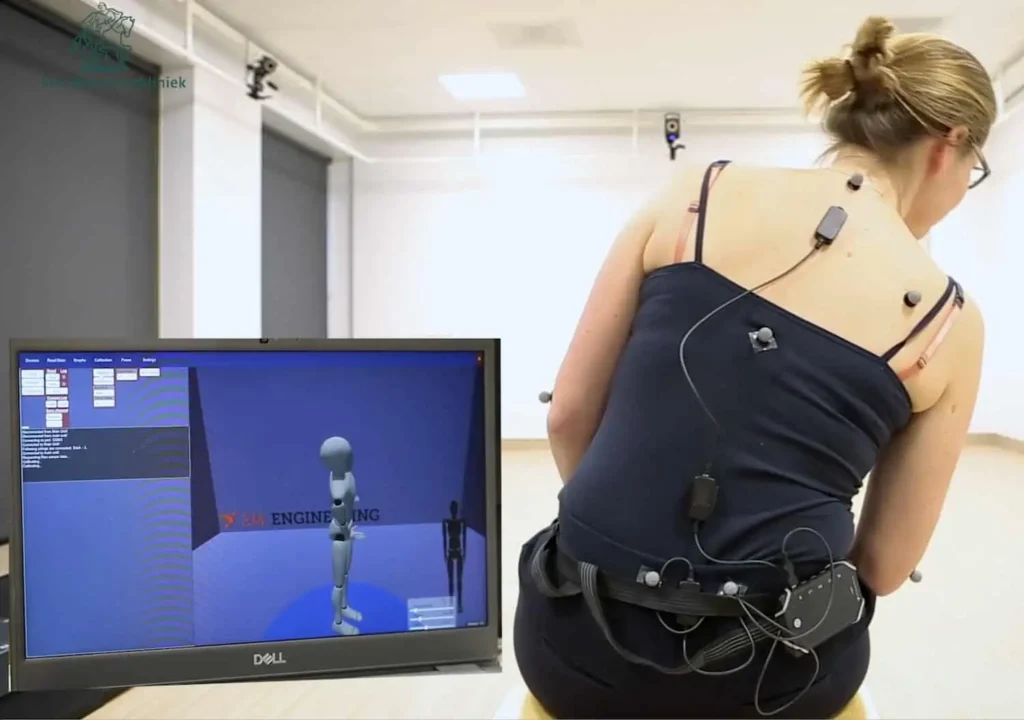
Motion tracking in virtual rehabilitation means measuring body or limb movement with cameras, depth sensors, inertial sensors or wearables and feeding that movement into virtual tasks, so clinicians and patients can practise, assess and adjust exercises. It is a measurement and training tool used alongside supervised therapy.
- What "motion tracking in virtual rehabilitation" means
- What is motion tracking in virtual rehabilitation?
- Motion tracking technologies: optical, depth, inertial and wearables
- Motion tracking technologies compared for clinical use
- Evidence in stroke, Parkinson's and upper-limb rehabilitation
- What movement metrics matter: ROM, speed, smoothness, trunk compensation
- User perceptions and usability: Llorens et al. 2014
- Limits and safety of digital movement metrics
- Conclusion
- Frequently asked questions
- Sources
What "motion tracking in virtual rehabilitation" means
Rehabilitation is defined as "a set of interventions designed to optimize functioning and reduce disability in individuals with health conditions in interaction with their environment", according to the World Health Organization. Motion tracking adds a measurement layer to that work: sensors record how the body moves during rehabilitation tasks, and the data drive on-screen exercises, record progress and help a therapist adjust difficulty or focus. The term is used across upper-limb, gait and balance work, but the principle is the same: movement becomes data that the person and clinician can act on. It supports therapy; it does not replace it.
What is motion tracking in virtual rehabilitation?
Motion tracking captures position, orientation, joint angles and movement trajectory. In virtual rehabilitation, those signals let a programme show a patient where their limb is in real time, count repetitions, or change the task when posture deviates. Optical systems follow reflective markers or body landmarks; inertial systems use accelerometers and gyroscopes; depth sensors estimate a body skeleton from distance data. Motion capture in virtual rehabilitation is therefore closer to clinical measurement than to entertainment tracking: the same sensor data can support feedback, session records and later review. The point is not simply to play a game. It is to give the therapist an objective, repeatable view of movement quality during practice. For example, a reaching exercise might report how far the hand travels, how smoothly it moves and whether the shoulder compensates.
Motion tracking technologies: optical, depth, inertial and wearables
Virtual reality motion tracking for rehabilitation draws on several sensor families.
- Optical marker-based systems track reflective markers with several cameras; they offer precise reference data but need controlled space and setup.
- Optical markerless systems follow body segments from camera images using computer vision; they are easier to set up but more sensitive to clothing, lighting and occlusion.
- Inertial measurement units (IMUs) combine accelerometers, gyroscopes and sometimes magnetometers in small wearable sensors; they are portable and do not need cameras, but they can drift over time.
- Depth sensors project infrared light and estimate joint positions in three dimensions; they work without body markers, though they are best within a limited range.
- Wearable sensors, including IMUs and stretch or pressure sensors, attach to limbs or clothing and can capture movement outside a clinic room.
Marker-based optical tracking is often treated as the reference in laboratory studies. Markerless and depth-based systems reduce setup time, which can matter in busy rehabilitation units. Wearable IMUs allow home practice but may need calibration before each session. No single technology is best for every clinical question.
Motion tracking technologies compared for clinical use
The table below compares the main motion capture options for virtual rehabilitation. It emphasises clinical criteria rather than technical specifications alone.
| Technology | Precision | Cost | Portability | Ease of use | Examples | Clinical validation |
|---|---|---|---|---|---|---|
| Marker-based optical | High in controlled spaces | High | Low; fixed cameras | Requires setup and calibration | Laboratory motion capture rigs | Often used as reference in gait and upper-limb studies; not routine in clinics |
| Markerless optical | Moderate; varies with light and occlusion | Low to moderate | Moderate | Simple for the user; analysis can be complex | Consumer depth cameras and RGB cameras | Growing; needs per-device validation in rehabilitation |
| Inertial measurement units (IMUs) | Moderate; can drift with time | Moderate | High; wearable | Simple to put on; needs calibration | Wearable sensor straps or suits | Used in telerehabilitation reviews; results depend on protocol |
| Depth / 3D sensors | Moderate within range | Low to moderate | Moderate | No markers needed | Depth cameras | Tested in movement screening and motor tasks; range limits apply |
| Magnetic / mechanical | Variable | Moderate to high | Low to moderate | Often physically restrictive | Some exoskeleton and body-mounted devices | Limited evidence in routine virtual rehabilitation |
These categories are not fixed: modern systems often combine markers, depth data and IMUs to compensate for each other's weaknesses. Validation in the intended clinical population matters more than the technology's theoretical accuracy.
Evidence in stroke, Parkinson's and upper-limb rehabilitation
Recent clinical summaries refer to a 2025 Cochrane systematic review on virtual reality for stroke and a separate Cochrane review on telerehabilitation. These reviews suggest that virtual reality and interactive tracking can support arm function, balance and daily activities, but effect sizes vary widely. The evidence is promising rather than settled: many interventions bundle motion tracking with other changes, making it hard to isolate the sensor's contribution.
Upper-limb work after stroke has been the most studied. Summaries describe improvements in motor control and activity performance during structured practice, but they also note that gains depend on dose, feedback and supervision. For Parkinson's disease, the World Health Organization highlights physical exercise training to improve muscle strength, voluntary movements and balance. Motion tracking can deliver that training in a standardised way, but it does not alter the underlying condition. Because the evidence base grows quickly, readers should check current systematic reviews rather than relying on a single trial.
What movement metrics matter: ROM, speed, smoothness, trunk compensation
- Range of motion (ROM) records how far a joint can move through a task.
- Movement speed captures the time needed to complete a reach or step.
- Smoothness measures changes in acceleration; jerkier movement often reflects reduced motor control.
- Trunk compensation describes the tendency to use the torso instead of the arm or hand, which game scores can miss.
These kinematic metrics matter because a high game score does not prove that the movement behind it was well performed. A user can reach a target by leaning or by using the other arm, and a depth sensor may still reward the result. That is why motion tracking sensors in rehabilitation should feed clinical measures, not just task success. ROM and trajectory data also allow therapists to compare sessions over time. Repeatable metrics support discharge decisions, home programmes and discussion with the person receiving rehabilitation. Clinical teams often combine a kinematic measure with standard assessments rather than replacing them.
User perceptions and usability: Llorens et al. 2014
A 2014 ICDVRAT conference paper by Llorens, Borrego and colleagues at the Computer Vision and Behaviour Analysis Lab and <a href="https://www.irenea.es" rel="nofollow">Irenea</a> examined how people perceived motion tracking during virtual rehabilitation. The authors framed usability around comfort, ease of use, fatigue and acceptance, and treated those perceptions as design feedback rather than proof of clinical effect.
Because the paper is a small usability study from one clinical context, its value lies in highlighting what users notice: whether the equipment feels comfortable, whether it is easy to move with, and whether fatigue limits practice time. Those factors matter as much as sensor accuracy in real sessions. The study does not establish that any particular tracker improves recovery. Such findings align with a wider point in clinical technology: a precise sensor that people will not wear, or that causes fatigue after ten minutes, has limited practical value. For that reason, usability testing belongs in the design of virtual rehabilitation programmes, not as an afterthought.
Limits and safety of digital movement metrics
Motion tracking introduces its own errors. Markerless systems can lose tracking when limbs cross, when lighting changes or when loose clothing confuses the model. Inertial measurement units can accumulate drift, and depth sensors lose accuracy outside their recommended range. These errors can make a movement look smoother or larger than it was. Clinicians therefore treat digital metrics as a support, not a standalone score. A drop in game performance may reflect a sensor problem rather than a change in ability, and a rise may come from trunk compensation rather than recovery. Systems should be calibrated, tasks should be standardised, and data should be confirmed with clinical assessment where possible. Motion tracking in virtual rehabilitation remains a training and measurement tool. It does not replace a qualified health professional, and no software setting should override clinical judgement. Anyone considering home equipment should discuss it with their rehabilitation team, and may wish to read the site's About page for context on how this publication selects and checks sources.
Conclusion
Motion tracking gives virtual rehabilitation its feedback loop: sensors measure movement, software turns it into a task, and clinicians use that record to adjust therapy. The evidence base is expanding but still varied, and the technology brings practical limits. Used alongside supervised care, it is a useful measurement and training aid, not a substitute for treatment.
Frequently asked questions
Is motion tracking the same as eye tracking?
No. Eye tracking measures gaze direction; motion tracking measures position and orientation of the body or limbs. They can be combined in a headset, but they answer different clinical questions.
How accurate are camera-based motion trackers for rehabilitation?
Accuracy depends on markers, distance, occlusion and the sensor model. A camera system that works well in a laboratory may be less reliable in a bright clinic or at home, so clinical accuracy should not be assumed without validation.
Does virtual reality with motion tracking improve stroke recovery?
A 2025 Cochrane systematic review on virtual reality for stroke suggests that interactive practice can support arm function, balance and daily activities, but effects vary and are often modest. It does not replace conventional therapy.
Do patients need a headset for motion tracking rehabilitation?
Not always. Depth-sensor and wearable systems can track movement without a head-mounted display, which may suit people with balance concerns or limited tolerance for immersion.
Can game scores replace clinical assessments?
No. Game scores may improve through trunk compensation, tracking errors or task familiarity. They should be confirmed with standard clinical measures.
Sources
- World Health Organization. "Rehabilitation." Fact sheet, 22 April 2024.
- Cochrane. "Virtual reality for stroke rehabilitation." Cochrane Database of Systematic Reviews, 2025.
- Cochrane. "Telerehabilitation for stroke." Cochrane Database of Systematic Reviews, 2025.
- Llorens, Borrego et al. "Subjective perceptions when using motion tracking in virtual rehabilitation." ICDVRAT, 2014.
- Computer Vision and Behaviour Analysis Lab, Universitat Politècnica de València.
- Irenea.
Further reading