
Virtual Rehabilitation Research in 2014: A Guide to the Studies and Themes

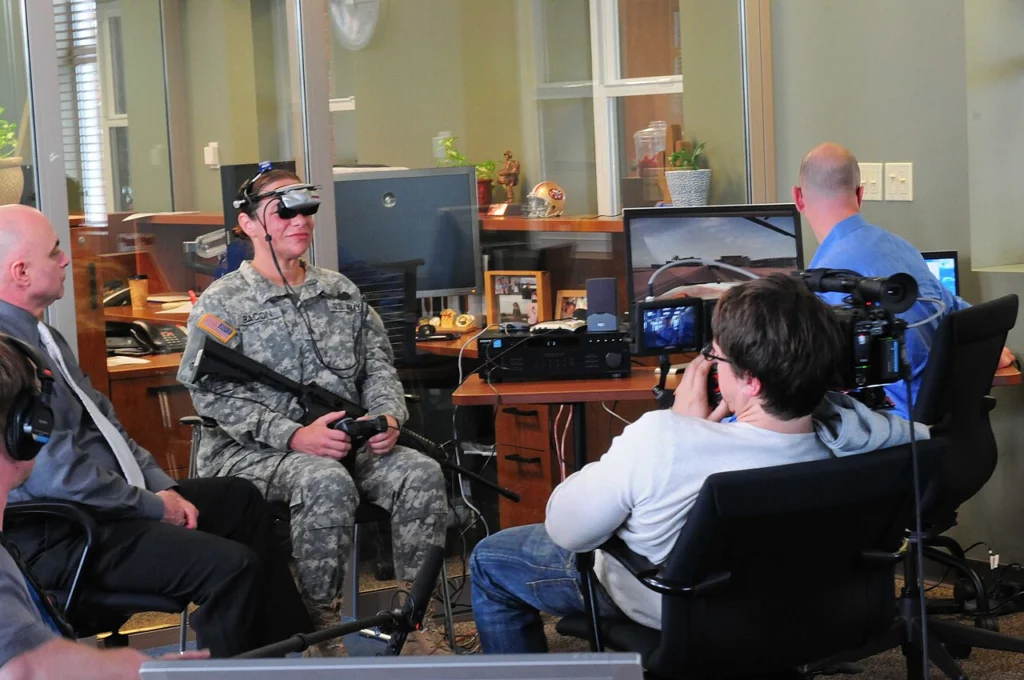
Virtual rehabilitation research in 2014 tested interactive simulations to support motor, cognitive and neglect-focused therapy, mostly in small clinical studies. The work appeared in PubMed, PLOS ONE and conference proceedings such as ICDVRAT. This page maps the main themes and links to open-access records instead of summarising clinical outcomes.
What was virtual rehabilitation research in 2014?
Virtual rehabilitation uses interactive computer simulations to let people practise movements or cognitive tasks, usually alongside conventional therapy rather than instead of it. In 2014, the field sat between two developments: custom-built virtual environments designed for clinics and cheaper commercial game systems entering therapy rooms.
A virtual environment is a computer-generated space in which a person can move and interact. It differs from a simple screen exercise because it responds in real time to what the user does. A head-mounted display covers the eyes and moves the view with the head; haptic feedback adds touch or force sensations to make tasks feel more physical. Not every 2014 study used these tools, but they defined the technical vocabulary of the period.
The International Conference on Disability, Virtual Reality and Associated Technologies was one of the venues where this work appeared. The ICDVRAT 2014 virtual rehabilitation papers formed part of a long-running series that brought together clinicians, engineers and researchers working on assisted and interactive technologies. Records from that period are now scattered across academic databases and institutional repositories, which is why a map of the sources helps.
The central interest of the year was not a single device or product. Researchers were trying to understand whether interactive practice could increase repetition, motivation and feedback in rehabilitation, while remaining safe and feasible for people recovering from stroke or living with other motor and cognitive conditions.
Where to find the 2014 studies
Several records from the 2014 virtual rehabilitation research landscape can be reached through public databases. The table lists the main entry points that appear in connection with that year, without reproducing titles or results that could not be verified.
| Source | Type of access | Why it appears |
|---|---|---|
| PubMed record 24681826 | Index and abstract record | A lookup point for one of the records associated with the 2014 search results. |
| PubMed record 24803644 | Index and abstract record | A second registry record from the same 2014 landscape; useful for tracing related work. |
| PubMed record 24763929 | Index and abstract record | A third record that helps show how the 2014 literature was distributed across journals. |
| PLOS ONE review by Lohse et al. (2014) | Full text, open access | A systematic review and meta-analysis of virtual reality for adults after stroke. |
| PMC full-text record | Full text, open access | A library copy of the same PLOS ONE review, held by the National Library of Medicine. |
| Aarhus University record | Index page and abstract | A 2014 study protocol for virtual reality upper-limb training after stroke. |
The PubMed rows are index records rather than full-text sources. They are useful for checking how a paper has been cited and for finding related studies, but the full text may sit behind a publisher page or require library access. For the PLOS ONE review, both the publisher page and the PMC copy are open access, so either route leads to the complete text.
Three research themes from the 2014 agenda
The 2014 virtual rehabilitation studies clustered around three main lines visible in the open records.
- Upper-limb motor training after stroke. Several records focused on arm and hand practice. The VIRTUES protocol, indexed at Aarhus University, planned a randomised controlled multicentre trial of virtual reality training for upper extremity recovery in people up to 12 weeks after stroke. Reading about how motion tracking works in virtual rehabilitation helps explain why accurate arm movement capture was a technical priority. Related research also explored brain-computer interfaces for upper-limb rehabilitation as a control method for people with limited movement.
- Cognitive and neglect-focused tasks. Some 2014 records included attention, spatial neglect and cognitive load among their outcome measures. Spatial neglect is a condition in which a person has difficulty attending to one side of space, often after a stroke. These studies were generally smaller and more exploratory than the motor trials, so their value lies in generating leads rather than in producing settled clinical guidance.
- Engagement and exergames. The PLOS ONE review examined both custom virtual environments and commercial gaming systems. Exergames are video games that require physical movement to play. The review found that commercial gaming interventions were too few and too small to assess their potential benefits, and it called for larger randomised controlled trials. This interest also connected with research on walking rehabilitation with treadmill virtual reality, where repetitive gait practice could be made more varied and interactive.
How to read 2014 evidence without overstating it
Not all 2014 studies carried the same weight. A pilot study tests feasibility and safety; it can suggest a direction but cannot settle a treatment question. A randomised controlled trial compares groups, but its usefulness depends on sample size, blinding and follow-up. A systematic review combines controlled trials and is usually the strongest starting point.
The clearest 2014 example is the review by Lohse and colleagues, whose full-text record is available from the National Library of Medicine. It pooled 26 controlled trials of virtual reality therapy for adults after stroke and reported moderate improvements over conventional therapy: a standardised effect size of 0.48 for body function and 0.58 for activity. That is a meaningful summary, but it reflects the trials available up to April 2013, not a guarantee of individual benefit.
Sample size matters when reading these numbers. Small trials can produce large-looking effects that shrink or disappear when more people are included. The PLOS ONE review handled this by combining trials, which is why its summary carries more weight than any single small study from the same period. Readers should also check whether a study was blinded and how long its follow-up lasted before treating its conclusions as stable.
Most other 2014 virtual rehabilitation studies were small and short. Their findings are better read as promising leads than as settled evidence, and they should be discussed with a qualified professional before anyone changes a rehabilitation plan.
What changed between 2014 and today
Virtual reality rehabilitation 2014 was built around clinic sessions, custom software and early commercial consoles. The PLOS ONE review closed with a specific research agenda: define conventional therapy more clearly, report participation measures, consider motivational components, and test commercial systems in larger trials. Those questions set the direction for much of what followed.
Current work extends well beyond upper-limb motor training. Separate streams now examine virtual reality for mental health and VR for cognition in older adults. These lines were present in early form during the 2014 period, but they have since gained larger trials and more detailed feasibility work. The most useful way to read the 2014 corpus is as a base layer: it established questions about movement, engagement and access that later research continues to refine.
The equipment has also changed. Headsets that required fixed workstations in 2014 have been replaced by lighter, consumer-level devices, and motion capture now works with ordinary cameras rather than dedicated sensor rooms. The underlying rehabilitation questions remain recognisable, but the tools used to study them are easier to deploy outside a research laboratory.
Sources
For further reading, start with the 2014 PLOS ONE review by Lohse et al., the full-text PMC copy of that review, and the VIRTUES study protocol at Aarhus University. The three PubMed records listed above are useful for citation tracing rather than for reading the papers themselves.
General information, not a substitute for professional medical advice.
Further reading