
Virtual Reality for Mental Health: How It Is Studied and What the Evidence Shows

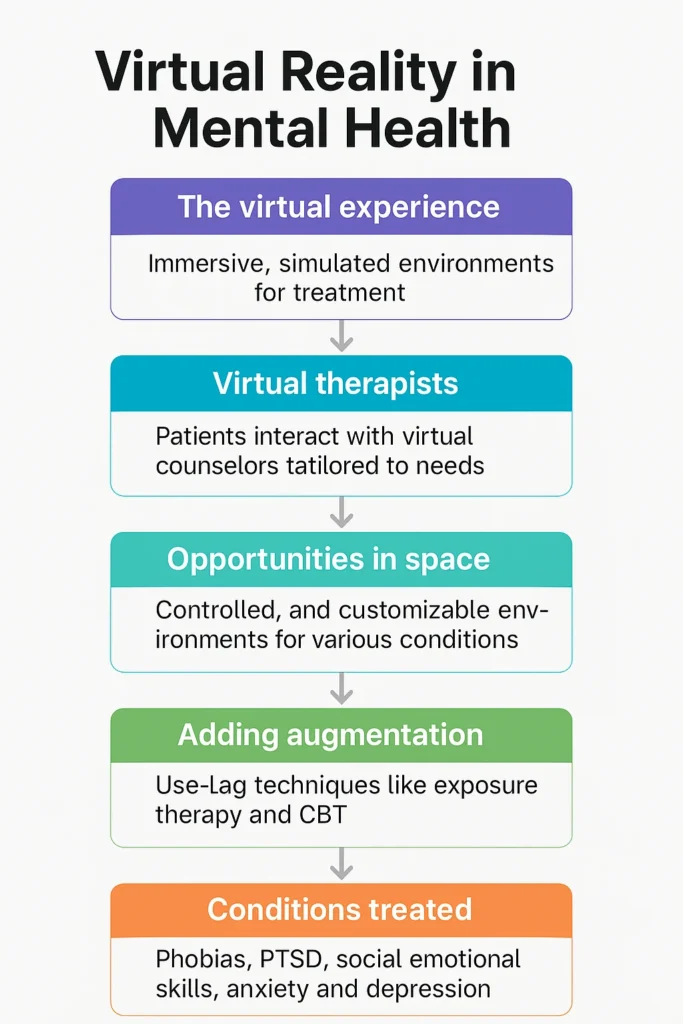
Virtual reality for mental health uses immersive, computer-generated environments in controlled sessions, usually as part of therapist-led exposure or practice rather than as a stand-alone treatment. Current evidence is strongest for specific anxieties and phobias; other uses remain small or preliminary, so findings should be read as promising leads, not settled therapy. A citable early survey of this field is the 2008 ICDVRAT paper by Rizzo and colleagues.
What Is Virtual Reality Therapy?
Virtual reality therapy uses immersive, computer-generated environments viewed through a head-mounted display during controlled sessions. A head-mounted display is a wearable visor that tracks head movement and presents a changing scene, which lets a clinician grade exposure or rehearse a task. The therapist can pause the simulation, ask how the person feels, and adjust the difficulty in real time. It is one form of virtual rehabilitation, which uses interactive simulations to support assessment and practice, usually alongside supervised therapy rather than instead of it.
The World Health Organization frames mental health as a state of well-being, not simply the absence of a disorder, and this technology is one narrow research tool within that wider field. The same immersive tools sit within the broader field of assistive technology, where devices support assessment, communication and daily function. Consumer VR mental health apps may offer relaxation exercises, but they do not by themselves provide the therapist-led assessment and dose control that define therapy.
How Researchers Use Virtual Reality in Mental Health
Researchers have tested virtual reality for mental health in three broad ways:
- Exposure: a controlled simulation presents a feared situation, such as a crowded bus or a high balcony, while a therapist adjusts the intensity. Scenes can be repeated and the difficulty increased in small steps, which is hard to arrange in a real street or clinic.
- Training and rehearsal: people practise social or everyday routines in a repeatable scene, a method related to how game-like training affects the brain. A person may rehearse getting on a bus or ordering in a café without needing the real situation to be available.
- Assessment: researchers track where participants look, how they move and how they respond in standardised tasks. These measures can support diagnosis or follow changes over time.
These categories overlap in practice; a single session might expose, train and measure at the same time. A 2008 ICDVRAT paper by Rizzo and colleagues surveyed these early psychology and rehabilitation uses, and this line of work later informed clinical trials.
Conditions Studied and Strength of Evidence
The evidence base is uneven. The most consistent reports come from specific phobia exposure studies, though many are small. PTSD results are mixed across trials. The 2022 gameChange randomised controlled trial offered a clearer signal for psychosis-related agoraphobia. Depression and social anxiety remain more exploratory. The table below summarises the main conditions, the VR method most often studied, and how the evidence should be read. Evidence markers below describe the type of study behind each condition, not a ranking of which therapy is best.
| Condition | Common VR method | Evidence marker |
|---|---|---|
| Specific phobias | Graded exposure simulations | Several small studies support use, but samples are often small |
| PTSD | Prolonged exposure with VR scenes | Mixed findings; individual responses vary |
| Social anxiety | CBT with VR rehearsal | Promising but not yet a settled first-line option |
| Psychosis and agoraphobia | Automated VR programme in the gameChange trial | A randomised controlled trial by Freeman and colleagues (2022)00060-7) reported reduced agoraphobic avoidance |
| Depression | VR-assisted CBT | Preliminary, with small or short studies |
For a closer look at military applications, see the evidence on VR for PTSD. Small pilot studies often produce encouraging results, which systematic reviews later moderate; the gameChange trial is notable because it was a randomised controlled trial rather than a small case series.
Session Protocols, Doses and Safety Limits
Safety limits matter alongside the wider pros and cons of immersive VR. Research protocols rarely rely on a single exposure, and most studies structure sessions around a fixed number and duration.
- In the gameChange trial reported by Freeman and colleagues, participants followed a structured programme of about six VR sessions, each lasting around 30 minutes.
- Cybersickness — nausea or dizziness triggered by the display — is a side effect that can occur during or after sessions. Trial protocols often include screening and supervision to manage it, which is why some studies compare head-mounted displays with flat-screen controls.
- These are research protocols, not personal prescriptions. Frequency and duration in any real-world service depend on clinical assessment.
Examples of VR Mental Health Applications
Virtual reality therapy examples in studies tend to be standardised scenes, not off-the-shelf apps. The main settings are:
- Everyday exposure: a bus ride, a supermarket shop, a café conversation or a visit to a GP surgery. Public transport and food shopping help researchers test avoidance in psychosis and anxiety.
- Fear-focused scenes: a take-off and flight for fear of flying, a high balcony for acrophobia, or a virtual audience for public speaking practice.
- Rehearsal tasks: practising social approaches or routine errands in repeatable simulations.
Consumer VR mental health apps may borrow similar scenes, but they are not equivalent to guided therapy. The same head-mounted display can run an exposure scene in a clinic or a game at home, but the clinical context changes how results are interpreted. In clinical research, the same underlying technology is also used outside healthcare, as shown by how VR is used outside clinical settings.
From the 2008 ICDVRAT Paper to Today’s Trials
For readers looking for a virtual reality therapy in mental health PDF, the 2008 ICDVRAT paper by Rizzo and colleagues is a citable starting point. At the 2008 ICDVRAT conference, the paper summarised early virtual reality applications in psychological research and rehabilitation. It mapped how immersive tools entered clinical study, and its value now is mainly as a historical baseline. It is a proceedings contribution, not a treatment guideline, so readers should read it as an early research snapshot.
Two decades later, the strongest new evidence comes from a specific automated programme rather than broader claims. The gameChange trial, reported by Freeman and colleagues in Lancet Psychiatry in 2022, tested a VR therapy designed for people with psychosis and agoraphobia. NICE has published an early value assessment of the programme for NHS use, which treats it as a defined digital therapy rather than a universal treatment. The shift from early surveys to registered trials shows how the field has matured.
Frequently Asked Questions
What is virtual reality therapy?
Virtual reality therapy uses immersive environments viewed through a head-mounted display, guided by a professional. It does not replace usual care on its own.
Is virtual reality therapy effective?
Evidence is most consistent for specific phobias and anxiety. The gameChange trial showed benefit for people with psychosis and agoraphobia, but many other areas remain preliminary.
What conditions does VR therapy treat?
Researchers have studied it for phobias, PTSD, anxiety, depression and psychosis-related agoraphobia, with varying strength of evidence.
Does VR therapy cause side effects?
Cybersickness — nausea or dizziness — is a side effect that can occur; clinical studies often screen participants and supervise sessions to manage it.
Sources
- Rizzo et al., ICDVRAT 2008 conference paper
- Freeman et al., Lancet Psychiatry (2022)
- NICE early value assessment on virtual reality for agoraphobia in psychosis
- World Health Organization, mental health fact sheet
This article summarises published research and is not medical advice; consult a qualified professional for individual concerns.
Further reading