
Disability Technology Research Topics

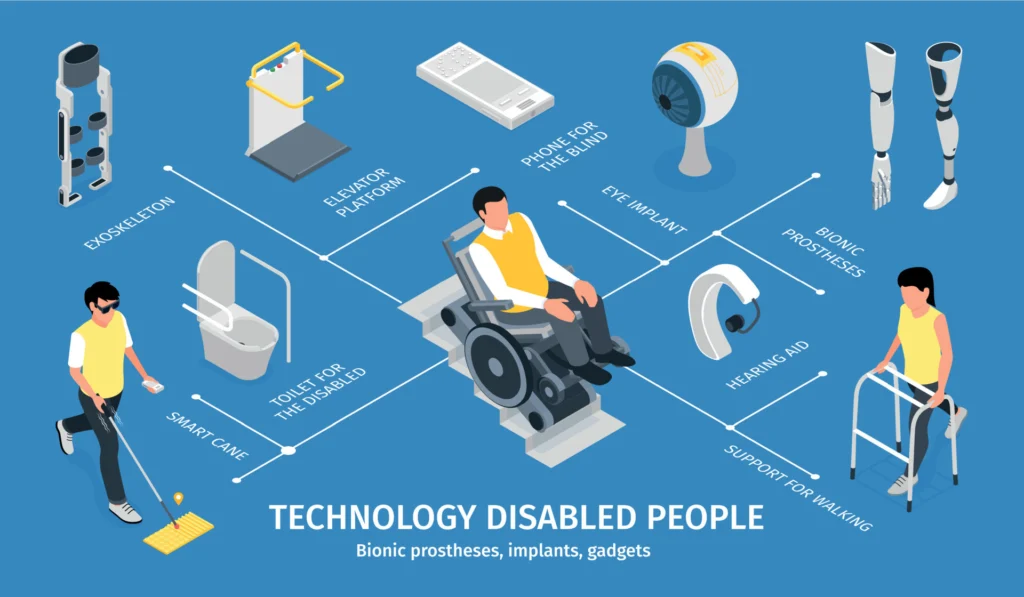
Disability technology research topics are the areas where academic study meets assistive and rehabilitation tools: motor rehabilitation with virtual reality and robotics, brain-computer interfaces and AAC for communication, sensory aids, accessible design, digital inclusion, and serious games. These ten topics, their trends, and starter questions are mapped below as a starting point rather than a ranked set of recommendations or clinical advice.
The World Health Organization reports that more than 2.5 billion people currently need one or more assistive products, a figure expected to rise to 3.5 billion by 2050. Assistive technology research spans motor rehabilitation, communication, sensory support, accessible design and digital inclusion.
What counts as a disability technology research topic?
A disability technology research topic sits where an assistive need meets a testable question about digital tools, robotics, virtual reality, artificial intelligence or augmentative and alternative communication (AAC). The World Health Organization defines assistive technology as an umbrella term for assistive products and their related systems and services, covering cognition, communication, hearing, mobility, self-care and vision. Digital assistive technology topics include speech recognition, captioning and screen readers, often studied alongside physical products such as wheelchairs and white canes.
A topic becomes researchable when it asks what works, for whom, under what conditions and at what cost. For example, a study might test whether speech-recognition software improves note-taking for university students with dyslexia. The key test is that the question can be answered with evidence, not opinion.
Ten research topics to watch in 2026
The ten topics below draw on six domains identified in a Structural Topic Modelling review of 211 disability technology articles published between 2015 and 2024 (Kiruthiga et al., 2026). Each entry pairs a research domain with a concrete starting point.
- Visual assistive technology and sensory aids: screen readers, smart glasses and image description for people with low vision; visual support is one of six WHO functioning categories.
- Cognitive-robotic interventions: robots that prompt attention, memory or daily tasks, tested in small studies; researchers ask whether cognitive support reduces dependence on caregivers without replacing human supervision.
- Virtual rehabilitation for motor recovery: VR and motion tracking allow repeated movement practice; the WHO reports 80 million people need a wheelchair and only 5–35% have access, showing the mobility gap.
- Accessible communication and sign-language technology: automated sign-language translation and captioning for education and employment; hearing aid production meets less than 10% of global demand for 1.5 billion people with hearing loss.
- AAC and speech recognition: speech-to-text accuracy, vocabulary design and switch access for people with limited speech; the WHO lists speech recognition and captioning as digital assistive solutions.
- Education and digital inclusion: assistive tools for school and work, such as screen readers and speech-to-text; timely provision for older people can improve independence and safety at home.
- Policy and governance of assistive technology: funding, regulation and distribution; WHO and UNICEF report access ranges from 3% in some low-income countries to 90% in some high-income countries.
- Brain-computer interfaces as assistive control: neural signals translated into commands for people with limited movement; research questions concern accuracy, fatigue and training time.
- Serious games for rehabilitation and skill building: play-based practice for therapy and learning; virtual rehabilitation normally works alongside, not instead of, supervised therapy.
- Disability data and outcome measurement: evidence on digital assistive technology development, adoption and outcomes; a Royal Society report from 2025 argues this evidence base needs strengthening.
Topic map by domain: technologies, trend and entry difficulty
The table compares the six STM domains by example technologies, broad trend signals and entry difficulty.
| Domain | Example technologies | Trend | Entry difficulty |
|---|---|---|---|
| Visual assistive technology | Screen readers, smart glasses, image description | Covered in 2026 STM review | Low to moderate |
| Cognitive-robotic interventions | Social robots, prompting aids, memory support | Small, exploratory studies | High |
| Rehabilitation technologies | VR, motion tracking, exoskeletons, powered wheelchairs | Active across prototypes | Moderate to high |
| Accessible communication and sign language | Sign-language translation, captioning, AAC | Machine-learning interest | Moderate |
| Education and digital inclusion | Screen readers, speech-to-text, accessible design | Cross-sector attention | Low to moderate |
| Policy and governance | AT funding, CRPD compliance, data systems | Persistent access gap | Moderate |
Entry difficulty is a pragmatic estimate for students and early-career researchers: a topic with low difficulty often has more published examples, while a high-difficulty topic usually requires technical partners or clinical access. The domains are not mutually exclusive; a serious game for stroke rehabilitation sits under both rehabilitation technologies and serious games.
The STM review groups articles by theme, so the domains work as a filing system rather than as clinical categories. Difficulty also depends on the setting: a university engineering lab, a clinic or a community organisation will face different constraints. Where the table says low to moderate, the barrier is usually access to existing tools; where it says high, the barrier is building or validating a new system.
What Structural Topic Modelling found in 211 articles
Structural Topic Modelling is a text-mining method that finds themes across a large set of documents. In a 2026 review, Kiruthiga et al. applied the method to 211 disability technology articles drawn from Web of Science and SCOPUS for the years 2015–2024. The model returned six themes: visual assistive technology; cognitive-robotic interventions; rehabilitation technologies; accessible communication and sign-language; education and digital inclusion; and policy and governance.
The review's practical sections treat visual assistive technology and cognitive-robotic work as areas of concentrated research attention, while the education and policy themes connect the field to broader inclusion goals. Because the underlying papers mix small pilots and larger studies, the review is better used to choose a topic than to settle a treatment question.
Its central value for a new researcher is a map of recurring themes rather than a ranking of effectiveness. The review does not measure clinical outcomes and should not be read as medical guidance.
How to turn a topic into a research question
A researchable question names a population, an intervention or technology, a comparison and an outcome; SPICE adds setting, perspective and evaluation for service-level studies. Instead of asking "Does virtual reality help?", ask "In adults with stroke-related upper limb weakness, how does home-based VR practice compare with standard exercises on movement frequency over eight weeks?" Digital assistive technology questions follow the same pattern: which users, which tool, compared with what, measured how.
The United Nations Convention on the Rights of Persons with Disabilities, particularly articles 4 and 26, frames accessibility and habilitation as rights rather than optional extras. For a policy question, the comparison may be two funding models rather than two devices. For a design question, the outcome may be task completion time or user confidence.
Write the question in one sentence before reading further; if it will not fit, narrow the population or the technology.
FAQ
What are some research topics related to disability?
Motor rehabilitation with virtual reality, brain-computer interfaces, augmentative and alternative communication, sensory aids, accessible design, digital inclusion and assistive technology policy all appear as live research areas. A practical first step is to choose one domain and ask what works, for whom and at what cost.
What are some interesting topics related to disability?
Cognitive-robotic interventions, sign-language technology, co-design with disabled users and disability data gaps are drawing attention. Co-design studies how users help shape a tool from the start, rather than testing it only at the end.
Can you give me 10 examples of adaptive technology?
Screen readers, speech-to-text software, switch access, AAC devices, powered wheelchairs, virtual reality rehabilitation, exoskeletons, smart glasses, haptic feedback and home automation are ten examples. The terms adaptive and assistive overlap, but the research questions are similar.
What are some helpful technologies for people with disabilities?
The World Health Organization states that more than 2.5 billion people need one or more assistive products. Helpful technologies reduce everyday barriers in tasks such as reading, communicating, moving and self-care.
Sources for disability technology research
The following published sources inform the data and definitions above. Where a source is cited in the text, its name appears here with a short note on its role.
- World Health Organization, fact sheet "Assistive technology", 2 January 2024. The WHO fact sheet supplies the global need figures and the definition of assistive technology used above.
- United Nations, Convention on the Rights of Persons with Disabilities, articles 4 and 26. The UN convention provides the rights framework for accessibility and habilitation.
- Royal Society, "The role of digital assistive technology", 2025. The Royal Society report examines digital assistive technology for a UK policy audience.
- Kiruthiga et al., "Thematic landscapes and temporal trends of disability technology adoption: insights from Structural Topic Modelling", 2026. The STM review is the source of the six research domains and the 211-article evidence base.
- About this site's editorial scope
- How we handle reader data
- Terms that govern use of this guide