
Sensor Glove Hand Rehabilitation Technology: What It Is and Whether It Works

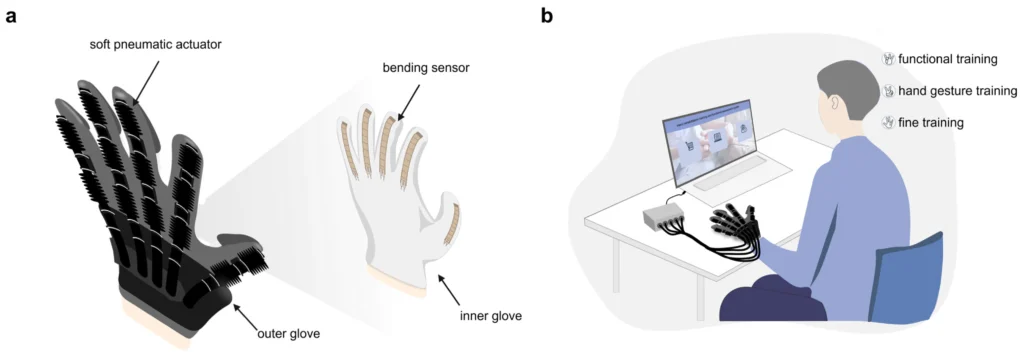
A sensor glove for hand rehabilitation is a wearable that uses motion, force or strain sensors to record hand, wrist and finger movement and give feedback during repeated exercises. It is mainly studied as an adjunct to supervised stroke therapy; current evidence is promising but comes mostly from small trials.
What is a sensor glove for hand rehabilitation?
A sensor glove is a wearable device that fits over the hand and records movement while a person practises hand, wrist or finger exercises. Most designs use three types of sensing: inertial measurement units (IMUs), which detect orientation and acceleration; bend or strain sensors, which measure how much a finger or wrist flexes; and force sensors, which record pressure from gripping or pressing. The glove sends this information to a computer, tablet or phone, where it can control a visual display or game and give the user feedback. In clinical settings, therapists may use the same data to track range of motion and repetition count during a supervised session.
The term “smart glove” often refers to the same category, although some smart gloves add actuators that move the fingers rather than only measuring them. That distinction matters because a sensor glove can be purely measuring, assistive, or both. For smart glove stroke rehabilitation, the usual aim is to support repetitive task practice without replacing a therapist. The technology belongs to the wider field of assistive technology, which covers tools that help people carry out everyday tasks.
How do sensor-driven rehabilitation gloves work?
Sensor input, feedback and repetition form the basic loop of most sensor-driven rehabilitation gloves. Sensors detect whether a movement is starting, how far it travels, and how much force it produces. That information is converted in real time into scores, visual prompts or game actions, which encourage the user to complete more repetitions. One published design for a soft glove combines force and strain sensing with assisted grasping, showing how measurement and support can sit in the same device. Commercial systems use a similar approach, translating sensor data into game-based exercises that target hand and wrist movement.
It helps to separate measurement from assistance. A sensor glove can monitor a movement even when the person produces all of the force; a robotic glove may add force, hold a position, or guide the fingers. Feedback can be visual, auditory or haptic, but the evidence base is stronger for systems used as part of therapist-led rehabilitation than for unsupervised home use. This distinction also explains why “smart glove” products with very different mechanisms can look similar in marketing.
Sensor glove vs pneumatic glove vs exoskeleton
Robotic hand rehabilitation gloves can take several forms, and the main distinction is between sensing, soft pneumatics and rigid support. A sensor glove measures movement and may provide feedback or mild stimulation. A pneumatic soft glove uses air pressure to bend or straighten the fingers, so it can assist movement and support grasping. A rigid hand exoskeleton uses motors or linkages around the fingers to guide movement with more force, but it is usually heavier and less portable.
| Category | Actuation | Sensing | Typical use | Example or study | Main limitation |
|---|---|---|---|---|---|
| Sensor glove | None, or electrical stimulation only | IMU, bend/strain and force sensors | Movement tracking, feedback and game-based exercise | Commercial systems for stroke and neurological rehabilitation | Limited physical assistance for very weak hands |
| Pneumatic soft glove | Air pressure through soft actuators | May include force or strain sensors | Assisted grasping and finger movement | Engineering studies of assistive grasping | Pressure control and comfort in longer sessions |
| Rigid hand exoskeleton | Motors or mechanical linkages | Position and force sensors | Guided movement with higher force | Research prototypes | Weight, cost and less tolerant fit |
These categories often appear together in product pages, press notices and academic papers, which can blur the differences. A sensor glove is not the same as a soft robotic glove or an exoskeleton, and the right choice depends on what the hand can already do. Someone with some active movement may benefit from feedback-based practice, whereas someone with little or no movement may need the physical support of a pneumatic glove.
None of these categories has large, long-term randomised controlled trials behind it. That does not mean the devices are useless; it means the published evidence is mostly engineering validation, small clinical studies or short-term feasibility work. The distinction between categories also helps when reading manufacturer claims, because a “robotic glove” may be a sensor glove, a soft pneumatic device or a rigid exoskeleton.
What does the evidence say?
The most direct clinical evidence comes from small studies of stroke rehabilitation. Kottink et al. (2022) assessed the therapeutic effect of a soft robotic glove on activities of daily living, a common outcome in upper limb research. The trial is part of a broader pattern: studies tend to be small, short and varied in how much therapy they provide. Most are best read as proof of feasibility rather than proof of effectiveness in routine care.
A separate line of work covers soft gloves for rehabilitation and assisted grasping. Zhu et al. (2022), writing in Sensors (Basel), described a wearable soft glove that combines force and strain sensing with assisted grasping in a single device. Engineering studies of this kind show that a device can work safely, but they do not by themselves show that patients improve. Earlier technical work, including a 2012 proceedings paper by Sivak et al., explored sensor gloves for hand rehabilitation before the soft robotic designs now common.
A 2023 prototype from the University of Southampton added textile electrodes and electrical stimulation to a glove and attracted press attention as an idea under development. That is an earlier stage than a completed clinical trial. Overall, the evidence supports supervised use in research settings, but there is not yet a large, multicentre randomised controlled trial that would settle the question of which patients benefit most.
The gaps are consistent across the literature. Sample sizes are often below fifty participants, follow-up is measured in weeks rather than years, and the devices differ enough that results do not always transfer from one glove to another. For that reason, the honest answer to “do robotic gloves work?” is that some small studies report improvements in movement or daily function, but the evidence is short-term and varied.
Access and cost in the UK
In England, rehabilitation after a stroke or a hand injury is usually arranged through local NHS services, with assessment by an occupational therapist or physiotherapist. The NHS website for England is the starting point for finding local services and understanding what the NHS covers. Public information about equipment provision is organised by condition and by local service, so someone asking about a smart glove should confirm with their treating team what is available in their area.
Without a national listing, someone who wants to try one may need to ask their therapist whether it is available at their service, join a research study, or buy privately. Prices vary widely, and private purchase raises questions about fitting, software support and clinical supervision. A therapist can also suggest simpler alternatives with a longer evidence base, such as task-specific practice, splints or programmes that do not require an electronic device. That route is often cheaper and easier to access while the evidence for smart gloves matures.
Arthritis, neuropathy and other uses
Most published evaluations of sensor gloves concern stroke and other neurological conditions. There are fewer studies that test these devices specifically for arthritis or peripheral neuropathy, and the findings do not yet provide a clear reason to use them for those conditions.
For arthritis, the mainstay of hand rehabilitation is usually exercise, joint protection and, where needed, splints; a sensor glove may help with feedback during exercise, but that is not established by high-quality evidence. For neuropathy, where sensation rather than movement is often the main problem, protective or padded gloves may help with comfort and safety, while sensor-based rehabilitation gloves remain largely untested.
The same caution applies to Parkinson’s disease and multiple sclerosis, which are sometimes mentioned in product pages. Small studies or clinic experience may support use, but the published evidence is thinner than for stroke, and a neurological therapist is the right person to weigh individual risks.
Frequently asked questions
Do robotic gloves work?
Some small studies report improved movement or daily function after supervised use, but evidence is short-term and varied.
What are some good hand gadgets for stroke patients?
Options include sensor gloves, therapy putty, splints and assistive devices; an occupational therapist should match the tool to the impairment.
Does the NHS provide gloves for arthritic hands?
Public information about NHS equipment provision is organised by condition and by local service; local occupational therapy may offer splints or other aids for arthritis after an assessment.
What are some good gloves for neuropathy in the hands?
Compression or protective gloves may help comfort or safety, but sensor-based rehabilitation gloves have little specific evidence for neuropathy.
What sensors are in a smart rehabilitation glove?
Usually motion sensors (IMU), bend/strain sensors and force sensors; electrode-based gloves add printed electrical stimulation.
Sources
NHS website for England, public information pages.
Kottink et al., “Therapeutic Effect of a Soft Robotic Glove for Activities of Daily Living,” 2022.
Zhu et al., “A Novel Wearable Soft Glove for Hand Rehabilitation and Assistive Grasping,” Sensors (Basel), 2022.
Sivak et al., proceedings paper on sensor gloves for hand rehabilitation, 2012.
University of Southampton, prototype glove with textile electrodes and electrical stimulation, 2023 (press reports).
Further reading