
Virtual Reality for Older Adults Cognition: What the Evidence Shows

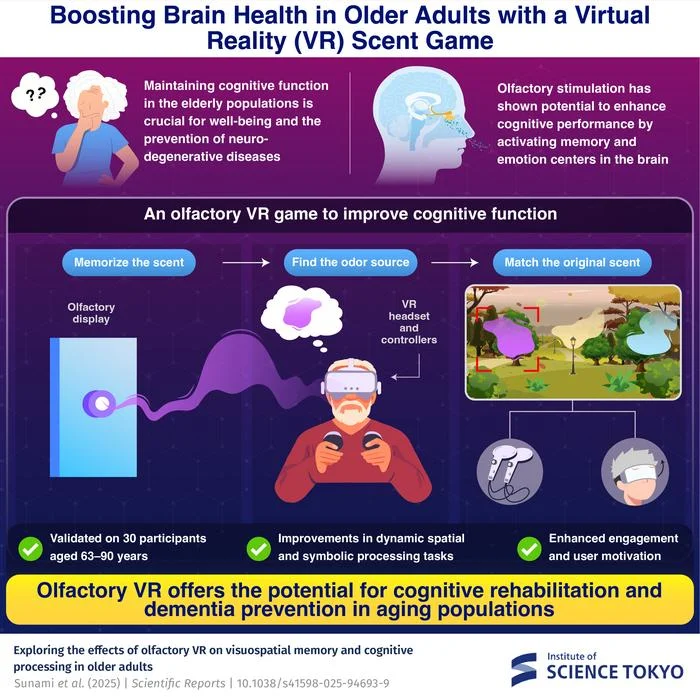
Virtual reality shows early signs of small gains in attention, memory and executive function in older adults. Most studies are small, short and use different designs. It is best read as a research tool used alongside normal care, not a proven treatment. No review concludes it reverses dementia. This guide explains the evidence in plain English and does not provide medical advice.
How does virtual reality aim to support cognition in older adults?
A head-mounted display is a headset that places screens in front of the eyes. It often includes motion tracking that updates the view as the person moves. In cognitive research, virtual reality creates interactive tasks that ask the brain to practise attention, memory, planning and switching between tasks. Dual-task training, which asks people to manage two tasks at once, is one way researchers use virtual environments to challenge everyday function.
The World Health Organization describes healthy ageing as the process of developing and maintaining the functional ability that enables well-being in older age. Virtual reality sits within a wider field of cognitive stimulation, alongside other interventions studied for older adults. It does not replace physical activity, social contact or clinical care. Most interventions target one of three domains: attention, working memory, or executive function such as planning and decision-making.
Attention training asks the person to stay focused on a target while ignoring distractions in the virtual scene. Working-memory tasks require holding and updating information, such as remembering a sequence of objects that appear in the environment. Executive-function exercises challenge planning, task switching and inhibition. Some programmes combine these domains with physical movement, an approach researchers describe as cognitive-motor or dual-task training.
What the research says so far
A systematic review by Anwar and colleagues (2026) pooled eight randomised controlled trials of virtual reality cognitive training for older adults with mild cognitive impairment. The review followed PRISMA 2020 reporting guidance and a PROSPERO-registered protocol. It found some positive signals for attention, memory and executive function, but the authors stressed that findings were inconsistent across trials and that the evidence remains limited.
A controlled study by Kantola and colleagues (2024) reported that virtual reality training performed better than a control condition on cognitive measures. The authors called for further high-quality trials to confirm the result, noting limitations in the available literature. A pilot study by Chaze and colleagues (2022) in long-term care focused on feasibility and on physical, emotional, cognitive and social well-being rather than confirmed cognitive improvement.
Kim and colleagues (2019) is a widely cited reference in this field, and the eight trials in the 2026 review vary in population, dose, device and outcome measures. Most samples are small and follow participants for short periods. For that reason, findings are better read as promising leads than as settled evidence. No high-quality review has shown that virtual reality reverses cognitive decline or dementia.
VR interventions compared: domain, dose and device
The table groups recent research by design and reported focus. Direct comparison is difficult because the studies use different populations, tasks, measures and reporting conventions. Where a study did not report a detail, the table says so rather than filling the gap.
| Study | Population | Cognitive domain | Dose per session | Device | Main finding | Study type |
|---|---|---|---|---|---|---|
| Anwar et al. 2026 (8 trials) | Older adults with mild cognitive impairment | Attention, memory, executive function | Varied by included trial; several used 20–60 minute sessions, 2–5 times per week for 4–12 weeks | Head-mounted displays in most trials; some used screens or projection | Small, short-term gains in attention, memory and some executive measures; evidence too limited for firm conclusions | Systematic review of randomised controlled trials |
| Kantola et al. 2024 | Older adults without dementia | Cognitive performance broadly | Dose not standardised in the review | Not specified in the abstract reviewed | Better than control; authors call for higher-quality trials | Controlled trial |
| Chaze et al. 2022 | Long-term care residents | Cognitive and emotional well-being | Session length and frequency not reported in the pilot account | Head-mounted display experiences selected for residents | Reported feasibility and well-being; no confirmed cognitive gains | Pilot study |
| Cheng 2025 | 30 older adults | Immersive learning and daily living skills | Qualitative study; no structured dose | Head-mounted display with a designed game | Qualitative findings on transfer to daily living | Qualitative study |
The empty cells reflect what the source texts state. Readers comparing interventions should treat missing dose or device information as a sign that the study reports less detail, not as evidence that a dose was absent.
Who should be cautious about virtual reality?
Virtual reality headsets are not suitable for everyone without preparation. Particular caution applies to people with epilepsy or a history of seizures triggered by flashing images, because some virtual reality content uses rapid visual changes. Cybersickness, a form of motion sickness triggered by virtual environments, can cause nausea and dizziness, so sessions should start short and stop if symptoms appear.
Uncontrolled vertigo or balance problems may make headset use unsafe without supervision. People with advanced dementia who experience agitation may find immersive headsets distressing rather than helpful. Recent eye surgery or other eye conditions that could be affected by headset use are also reasons to seek clinical advice first. The World Health Organization's dementia materials emphasise that dementia is a syndrome, not a normal part of ageing, and that care should be individualised.
Talk to a health professional before using virtual reality with a person who has any of these conditions. No review recommends virtual reality as a treatment for dementia or as a substitute for supervised care.
How to judge a VR cognition study
The 2026 systematic review assessed risk of bias, a standard step that checks whether a trial's design could distort its results. A useful study should describe four things clearly. First, the sample: enough people, with a defined condition, to detect a real effect. Second, the comparison: a control group that lets researchers separate the virtual reality effect from attention or expectation. Third, the outcome: a validated test of attention, memory or executive function rather than a self-report alone. Fourth, the transfer: evidence that gains appear in daily life, not only inside the headset. Studies that miss these details should be read with more caution.
The risk-of-bias assessment helps readers spot trials where allocation was unclear or where assessors knew which group a participant was in. For a non-specialist, the four checks above are a practical shortcut. They also explain why a single small study rarely settles a question: the result may depend on the task, the measure or the people chosen. Systematic reviews matter because they gather the small studies and look for a pattern.
Frequently asked questions
How does aging affect cognition? Normal ageing slows processing speed and working memory. That is not dementia.
What are the four levels of cognitive impairment? Usually described as no impairment, subjective cognitive decline, mild cognitive impairment (MCI), and dementia. Boundaries are clinical.
How to help cognitive decline? Physical activity, social and cognitive stimulation, and managing blood pressure and hearing loss. Virtual reality is one emerging tool, not a treatment.
What are the symptoms of age-related cognitive decline? Forgetting recent events, slower recall, and losing track in multitasking. If it affects daily life, seek clinical assessment.
Does virtual reality improve memory in older adults? Some small trials report better attention and memory. Findings remain preliminary and inconsistent.
Sources
PubMed. Index of biomedical literature from MEDLINE, life science journals and online books.
World Health Organization. Healthy ageing and dementia resources. Available from the World Health Organization website, linked above.
NHS website for England. Health information and guidance. Available from the NHS website, linked in the cautions section below.
Anwar et al. (2026). Virtual reality–based cognitive training for older adults with mild cognitive impairment: systematic review of randomised controlled trials. Indexed in PubMed.
Kantola et al. (2024). Virtual reality cognitive training in older adults. Indexed in PubMed.
Chaze et al. (2022). Virtual reality and well-being in older adults: pilot implementation in long-term care. Indexed in PubMed.
Cheng (2025). A virtual reality game for older adults' immersive learning. Indexed in PubMed.
Kim et al. (2019). Referenced in the wider virtual reality and cognition literature. Indexed in PubMed.
Editorial standards for this site are set out on the about our editorial standards page. The privacy policy and terms of use apply to all content.
This article does not provide medical advice. Talk to a health professional before using virtual reality with a person with cognitive impairment.
Further reading