
Treadmill Virtual Reality Walking Rehabilitation

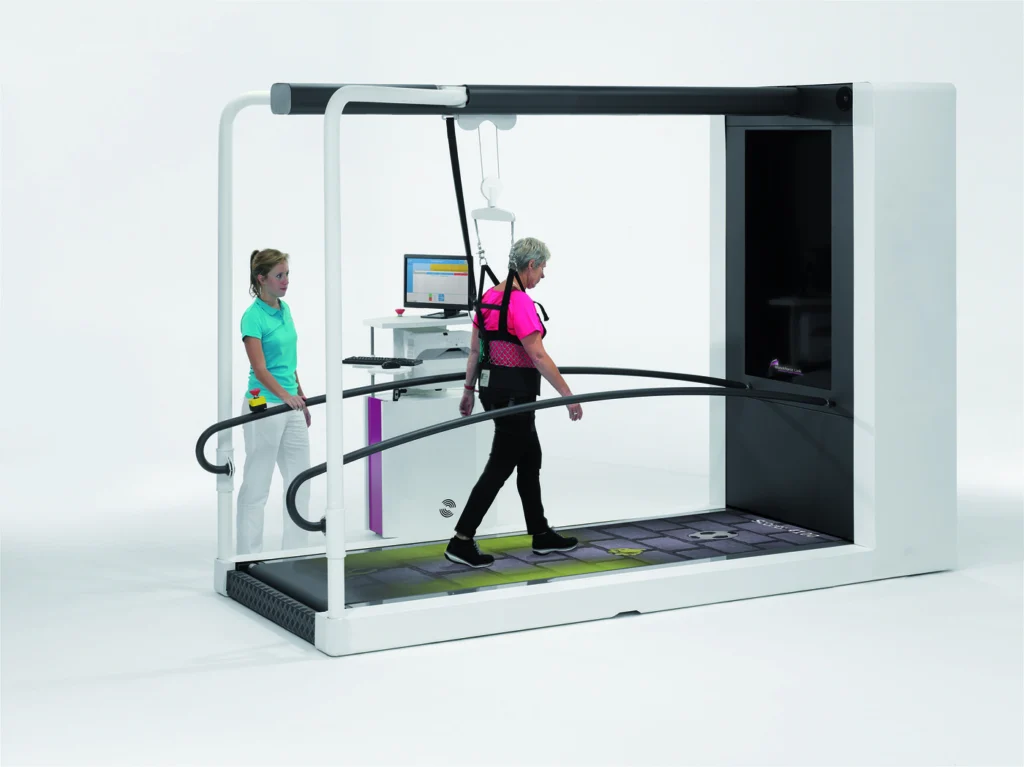
A treadmill virtual reality walking system pairs a treadmill with a display or head-mounted display and motion tracking. During rehabilitation, software can adjust belt speed or feedback in real time, as proposed in the ICDVRAT 2012 speed-control algorithm, so gait practice can be standardised and measured. Existing findings are promising but mostly from small, short studies.
What treadmill virtual reality walking rehabilitation is
Treadmill virtual reality walking rehabilitation is a form of gait rehabilitation that combines treadmill walking with an interactive visual environment. In treadmill-based virtual reality, the user walks on a motorised treadmill while viewing a virtual scene on a screen or through a head-mounted display. Motion tracking captures how the person moves, and the software can use that information to change what the person sees or how the treadmill behaves.
The aim is to create a controlled setting for practising walking, balance and speed changes. Because the treadmill and the virtual environment can be adjusted, researchers and clinicians can repeat conditions and record movement data more consistently than in everyday walking. The approach is studied mainly as a complement to supervised therapy, not as a standalone treatment. Most published work in this area is experimental rather than established clinical practice.
Key components and terms
- Treadmill: a motorised belt that sets the walking speed and can be adjusted to a fixed or real-time target.
- Head-mounted display (HMD): a headset that shows the virtual scene and moves with the user's head; some systems use a large screen instead.
- Motion tracking: sensors or cameras that record body position and movement while the person walks.
- Augmented feedback: visual or auditory cues added to the exercise, such as step length, pace or body position.
- Real-time treadmill speed control: a control loop that links motion tracking signals to the treadmill so belt speed can change during the session.
- C-Mill treadmill: a specialist treadmill that projects virtual paths and obstacles onto the walking surface, used mainly in research and rehabilitation centres.
These terms appear throughout the literature on treadmill-based virtual reality and gait rehabilitation, and they help distinguish systems that simply show a video from those that respond to movement.
How real-time treadmill speed control works
Real-time treadmill speed control is a control-loop method that changes belt speed while the person is walking, based on signals from motion tracking rather than on a preset programme alone. In a standard treadmill, a speed is set before walking. In real-time control, sensors measure the walker's movement, a control algorithm compares that measurement with a target, and the treadmill adjusts the belt speed in response.
The process repeats in a loop, so speed changes follow the person's movement with little delay. At each stage, the measured movement signal enters the controller, the controller updates the speed command, and the treadmill actuates the command; the resulting movement is then measured again.
The approach was formalised for virtual reality gait research in a paper by Al-Amri et al. presented at ICDVRAT 2012 and listed under Real-time Treadmill Speed Control Algorithm on the Cardiff University profile. The paper sets out a real-time treadmill speed control algorithm: movement signals are processed in a control loop, and the treadmill speed is updated from those signals. The contribution is technical rather than clinical; it gives researchers a way to co-ordinate the treadmill with the virtual environment and with movement data.
A real-time system can keep belt speed standardised and repeatable across sessions, and it lets researchers study speed adaptation without stopping to reset the belt. Those properties are useful for measurement, but they do not by themselves show that one training regime is better than another.
What the evidence shows
Evidence on virtual reality treadmill gait training is limited, and most published findings come from small or short investigations rather than large trials.
| Study | Population | Measure | Finding |
|---|---|---|---|
| Shema et al., 2014 | Older adults | Mobility, balance and fall risk | Reported positive changes after a five-week treadmill training programme with virtual reality. |
| NCT05623462 (ClinicalTrials.gov registration) | Older adults using a C-Mill treadmill | 10-Metre Walk Test (10MWT) | A registered randomised controlled trial; the record lists the 10MWT among its outcome measures but does not yet report findings. |
| SCIRE systematic review | People with chronic spinal cord injury | Gait measures from virtual reality treadmill studies | A systematic review of virtual reality gait rehabilitation; findings point to possible benefits but remain limited by small samples. |
These sources suggest that treadmill-based virtual reality can be tested safely in supervised settings and that short programmes may improve mobility and balance. However, the studies are small, follow-up is limited, and the evidence is not yet strong enough to support general clinical recommendations. Measures recorded in this literature commonly include walking speed, balance, fall risk and gait symmetry.
Advantages and limitations
The main advantages are control and measurement; the main limitations are small samples and short follow-up.
Advantages:
- Standardised environment: the same speed, visual scene and task can be repeated across sessions.
- Real-time control: belt speed can change while the person walks, which may support training for speed changes and adaptability.
- Controlled safety: treadmill research often includes a harness or supervision, allowing fall-related measures to be studied more safely.
- Measured movement: motion tracking and augmented feedback can record step length, speed and gait symmetry.
Limitations:
- Limited evidence: most studies are small and brief, so findings are promising but not conclusive.
- Access: systems such as the C-Mill treadmill are found mainly in specialist centres, not in everyday fitness settings.
- Unclear long-term effect: many trials focus on short-term measures such as the 10MWT or balance tests.
- No standard price: cost depends on centre, equipment and health system.
What a session involves and current availability
A supervised virtual reality treadmill session typically combines a treadmill, a display and motion tracking, and is available mainly in specialist rehabilitation and research centres. A session may begin with setup and calibration so the tracking system recognises the person's movement. The therapist or researcher selects a task, such as walking at a set speed, following a virtual path or stepping around obstacles. The person walks while the system records movement and adjusts the scene or belt speed. A support harness may be used for safety, especially with older adults.
Systems that project virtual trails onto the walking surface, such as the C-Mill treadmill, are found mainly in hospitals, universities and specialist rehabilitation centres rather than in typical gyms. Prices are not published as a standard rate; cost depends on the centre, the equipment and the local health system, so asking a local clinic is the reliable way to get an estimate. More background on how this site approaches assistive technology topics is available on the About this site page.
Frequently asked questions
Can virtual reality be used for exercise?
Yes. Virtual reality can make exercise sessions more engaging and can provide feedback on movement, but in rehabilitation it usually accompanies supervised therapy rather than replacing it.
Do physical therapists use treadmills?
Yes. Physical therapists use treadmills for gait training, to assess walking patterns and to control speed, often in safe settings with a support harness where needed.
Is there a treadmill that has virtual trails?
Yes. Systems such as the C-Mill treadmill project virtual routes and obstacles onto the walking surface, mainly in research and rehabilitation centres.
How much does VR therapy cost?
There is no standard public price. Cost depends on the centre, equipment and health system, so it is best to ask a local clinic directly.
Is VR treadmill training safe for older adults?
Studies in older adults have used harnesses or supervision and report promising but not conclusive findings; safety depends on individual assessment by a clinician.
Sources
- Al-Amri et al., "Real-time Treadmill Speed Control Algorithm", Proceedings of ICDVRAT 2012, listed on the Cardiff University profile.
- ClinicalTrials.gov, NCT05623462, C-Mill treadmill training study record.
- Shema et al., "Clinical Experience Using a 5-Week Treadmill Training Program with Virtual Reality", 2014.
Further reading